

.png)
.png)
.png)
%201.png)
.png)
Choosing the right AI compliance software can mean the difference between running a proactive cyber risk program and constantly playing catch-up. With regulations like SEC cybersecurity disclosure rules, NIST frameworks, and industry-specific mandates piling up, you need tools that do more than generate dashboards. You need a platform that automates assessments, prioritizes findings, and translates risk into language your board understands.
CyberSaint built the CyberStrong platform specifically for enterprise cybersecurity leaders and compliance teams facing this challenge. This guide walks you through the evaluation criteria that matter most when selecting AI-powered compliance and risk management software.
Key Takeaways
- Evaluating AI compliance software in 2026 comes down to substance over dashboards: prioritize platforms that automate evidence collection and control monitoring to cut assessment time by 70% or more.
- The AI that matters translates cyber risk into financial terms, so you can justify budget and communicate posture to the board in dollars rather than maturity scores.
- Insist on transparent, recognized cyber risk quantification (CRQ) methodologies, FAIR and NIST 800-30, not opaque proprietary scores you can't defend to an auditor or a CFO.
- Framework harmonization is non-negotiable: assess a control once and apply the evidence across every standard it maps to, from NIST to ISO to PCI DSS.
- CyberStrong connects controls to risks for real-time cyber risk analysis and executive reporting, grounded in agentic evidence collection and one of the world's largest cyber loss datasets.
Buying Past the Dashboard
Every AI compliance vendor can show you a clean dashboard. That's not the hard part, and it's not what separates a proactive cyber risk program from one that's permanently playing catch-up. The hard part is what happens underneath: whether the platform actually automates risk assessments, prioritizes the findings that matter, and translates technical risk into language your board can act on.
The pressure to get this right keeps climbing. SEC cybersecurity disclosure rules, NIST frameworks, and a growing stack of industry mandates all expect a current, defensible view of your posture, not a snapshot you assembled the week before an audit. And you're expected to produce it with a team that's almost certainly stretched thin.
This guide walks through the evaluation criteria that actually distinguish AI-powered compliance and risk platforms from point solutions with an AI label. CyberSaint built the CyberStrong platform for exactly this challenge, and the criteria below are the ones worth holding any vendor to.
What Is AI Compliance Software, and Why Does It Matter Now?
AI compliance software uses machine learning and automation to handle cybersecurity governance, risk, and compliance work. It ingests data from your existing security tools, cloud environments, and business systems to score controls, surface gaps, and generate audit-ready evidence — the tasks that used to consume analyst weeks.
The shift toward automation is answering a resource problem you can't hire your way out of. ISC2 puts the global cybersecurity workforce gap at 4.8 million professionals, and ISACA reports 55% of security teams are understaffed. Automation absorbs the repetitive work, evidence collection, documentation, and crosswalking, so your team spends its time on strategic risk decisions instead of chasing screenshots.
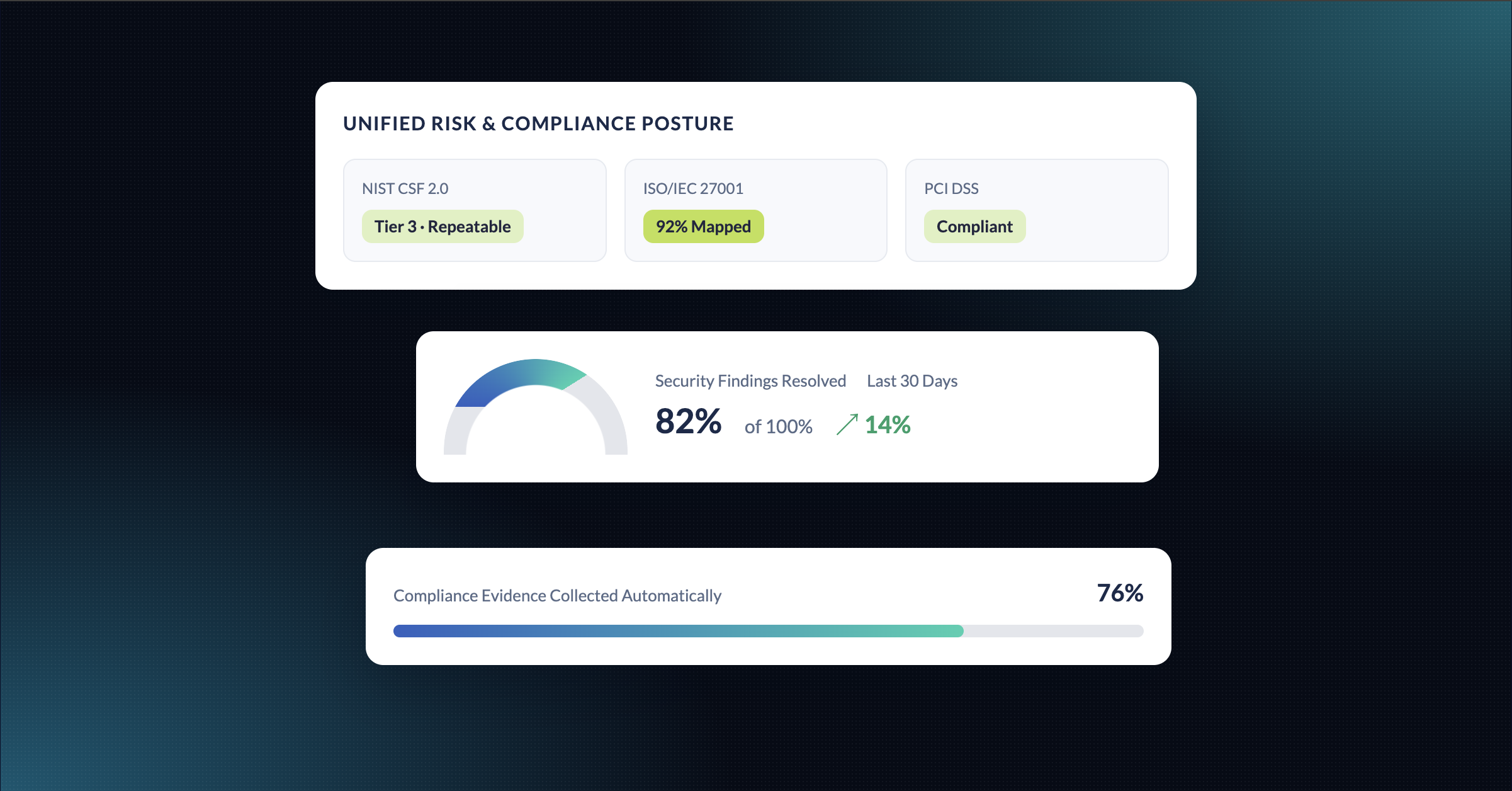
It also solves a communication problem. Executives and boards want cyber risk in business terms, not technical jargon. The right platform quantifies your posture in dollars, which is what makes budget requests defensible and turns a security update into a board-level decision. That combination —filling the capacity gap and closing the language gap—is why AI compliance software has moved from convenience to expectation.
How Does AI Improve Cybersecurity Compliance Assessments?
AI improves compliance assessments in three concrete ways, and understanding them is how you separate real capability from a marketing claim during evaluation.
The first is automated evidence collection and control scoring. AI-powered platforms pull data directly from your stack through API integrations with vulnerability scanners, SIEM tools, identity providers, and cloud platforms, which eliminates the manual hunt for screenshots and status updates. CyberSaint's agentic evidence collection goes further, deploying autonomous agents that operate within your security guardrails to validate evidence on an ongoing basis.
The second is framework crosswalking. Most enterprises track NIST CSF, ISO 27001, SOC 2, and industry mandates like HIPAA or PCI DSS at once, and mapping controls across them by hand is pure duplicated effort. AI-powered crosswalking analyzes your control library and maps evidence to every applicable standard automatically, so documenting a control for NIST applies that same evidence to the corresponding ISO and PCI requirements. Assess once, satisfy many.
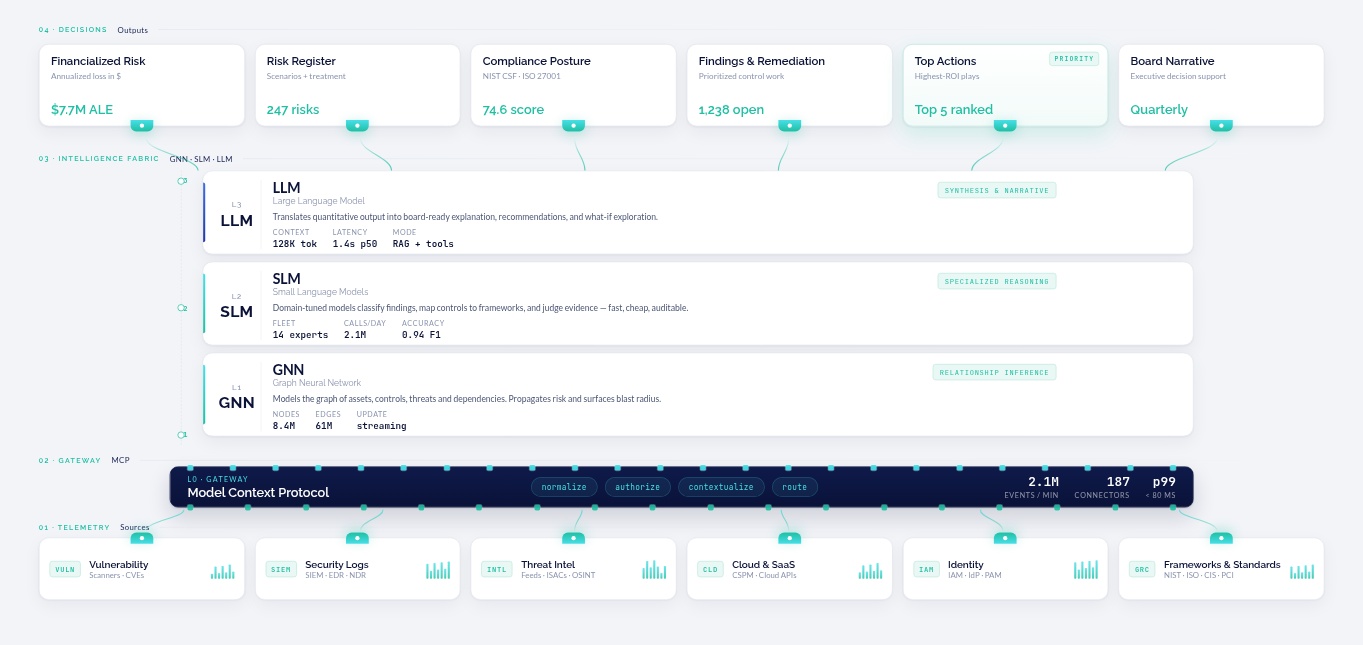
The third is intelligent findings prioritization. Security teams drown in thousands of findings with no clear order of attack, so low-impact issues eat time while critical gaps sit open. AI weighs exploitability, asset criticality, threat intelligence, and business impact to surface what matters most. CyberSaint's findings management uses patented graph neural network (GNN) technology to map threats to controls and risks, so prioritization reflects your organization's specific exposure rather than a generic severity score.
What Evaluation Criteria Actually Separate Platforms?
Marketing materials blur together. These are the criteria that reveal whether a platform does the work or just displays it. Use the table below as a scoring sheet in your demos and pilots, then read on for what each criterion means in practice.
|
Evaluation criterion |
What strong looks like |
Warning sign |
|---|---|---|
|
Integration depth |
Pulls granular configuration data and scores controls against live system state |
Confirms a tool exists but can't read its settings |
|
Cyber risk quantification (CRQ) |
Transparent FAIR / NIST 800-30 models you can walk a CFO through |
Proprietary "black box" score no one can explain |
|
Board-ready reporting |
Exposure in dollars, trend lines, and RoSI generated from the system |
Technical dashboards that need a separate deck to translate |
|
Scalability & time to value |
Live and generating insight in ~1 week; scales across units and frameworks |
Multi-month professional-services rollout before any value |
|
AI accuracy controls |
RAG-grounded outputs with source citations and human review gates |
Confident generative answers with no traceable source |
|
Data privacy & governance |
Data stays in your tenant; opt-out of model training; RBAC on AI features |
Customer data trains shared models with no opt-out |
|
Continuous monitoring |
Automated technical checks plus workflows for human-verified controls |
A green dashboard treated as proof of a clean audit |
Integration depth matters more than integration count. A shallow integration confirms a tool exists in your environment; a deep one pulls granular configuration data, validates specific settings, and scores controls against actual system state. Ask any vendor to demonstrate integrations with your specific tools and to spell out exactly what data points each one collects and how that becomes a control score. CyberStrong's integration ecosystem connects vulnerability management, cloud providers, identity systems, and SIEM tools into a single view of control posture.
CRQ methodology is where credibility lives or dies. Some platforms lean on proprietary algorithms that function as black boxes — you can't explain the score to your board or your auditor because you don't know how it was produced. Credible platforms support recognized models like FAIR and NIST 800-30, which translate risk into financial terms transparently. When your CFO asks how you arrived at a $5 million loss estimate, you should be able to walk through it step by step. CyberSaint enables cyber risk quantification through model-agnostic support, backed by one of the world's largest cyber loss datasets, Advisen.
Board-ready reporting is a capability, not a slide template. Your executives need posture in business terms without wading through technical detail. Check whether you can generate a board presentation directly from the system and whether it shows return on security investment (RoSI) for remediation.
Scalability and time to value close the list. Enterprise deployments have to scale across business units, geographies, and frameworks, so ask about the largest implementations a vendor runs and how many controls the system manages. Time to value matters because compliance deadlines don't wait for a six-month rollout; CyberSaint customers are typically live and generating insight within one week.
How Do You Validate AI Accuracy and Prevent Hallucinations?
Generative AI introduces a specific risk you have to address head-on during evaluation: a large language model can produce confident, fluent output that is simply wrong. In a compliance context, that's not an inconvenience — it's liability.
The defense is grounding. The NIST AI Risk Management Framework (RMF) emphasizes human oversight and traceability, and AI outputs should trace back to specific source documents rather than generating plausible text from training data. When a platform uses generative AI for questionnaire responses or policy drafting, ask whether it uses Retrieval-Augmented Generation to ground answers in your uploaded policies, SOC 2 reports, and past responses. The system should cite its sources and flag low-confidence answers for review.
Human oversight is the second half. No AI compliance tool should push critical output to an external party without a subject-matter expert in the loop. Ask vendors to show their approval workflows: can you see exactly which document generated each answer, and is there a version history recording who approved what? If the answer is vague, treat that as the answer.
What Should You Ask About Data Privacy and AI Governance?
You're handing this software sensitive material, vulnerability reports, employee data, strategic roadmaps, so the vendor's own AI governance matters as much as the feature list.
Start with training data. Some vendors aggregate customer data to train shared models, which improves accuracy but introduces data-leakage risk that's unacceptable in highly regulated industries. Verify there's an opt-out, and that the security documentation states plainly that your proprietary data stays in your tenant and never trains a shared model. Then check access control. AI capabilities should respect your existing framework; a sales rep answering a security questionnaire shouldn't reach raw vulnerability scan results. Confirm the platform enforces role-based access control on AI features, governing both who can invoke a given capability and what data that capability can touch.
What to Look for in Continuous Control Monitoring (CCM)
Compliance isn't an annual event, and a green dashboard isn't a clean audit. Effective AI compliance software catches issues before they become findings, but you have to know what monitoring can and can't do.
Automated monitoring can confirm encryption is installed on every laptop. It can't, on its own, verify that your offboarding policy was actually followed for a recent termination. A capable platform supports both automated technical checks and workflows for human-verified administrative controls, and doesn't pretend the first covers the second. CyberSaint's continuous control monitoring scores controls automatically as data changes across your stack, replacing point-in-time assessments with dynamic visibility.
Expect a baselining period, too. When you first connect the platform, it will flag hundreds of potential failures, many of them false positives or accepted risks. The first 30 to 90 days are for tuning — marking non-production environments out of scope, documenting risk acceptances, and mapping platform controls to your internal terminology. That work makes ongoing monitoring accurate.
How Do You Build the Business Case?
Securing budget means translating the platform into numbers finance and executives recognize.
The clearest lever is time saved. Track what your team spends today on evidence collection, assessment documentation, crosswalking, and reporting, then apply the reduction automation delivers; CyberStrong users report an average 70% time savings across assessments, against your current labor cost. From there, layer in risk reduction: faster gap identification and remediation shrinks the window a vulnerability stays exposed, and you can estimate that value against the cost of incidents faster remediation prevents. Then add audit cost.
Inefficient programs turn every audit into a fire drill that burns staff time and often external consultants; automated evidence collection and organized documentation cut that preparation cost directly. Three quantifiable savings, all in the language the budget owner already speaks.
Choosing AI Compliance Software That Delivers
Evaluating AI compliance software in 2026 is an exercise in looking past the demo. Weigh integration depth, risk quantification methodology, board-ready reporting, and the vendor's own AI governance, and test every platform with your own data before you commit.
The right software doesn't just automate the workflows you already have. It changes how you manage cyber risk by connecting controls to risks, risks to financial impact, and remediation to business value. CyberSaint built CyberStrong on that principle: automated assessments, transparent CRQ, and executive dashboards that speak to the board, across the full cyber risk management lifecycle. Enterprise customers use it to move from spreadsheet-based processes to data-driven programs that scale.
FAQs About How to Evaluate AI Compliance Software in 2026
How do you evaluate AI compliance software in 2026?
Evaluate it on substance, not dashboards: integration depth with your actual security stack, transparent CRQ, board-ready financial reporting, and the vendor's own AI governance around training data and access control. Test each platform with your own data during a demo or pilot, and confirm you can export your evidence history. CyberStrong is built to meet these criteria, connecting controls to risks for real-time quantification and executive reporting.
What is the difference between AI compliance software and traditional GRC tools?
AI compliance software automates work traditional GRC tools leave to people. CyberStrong scores controls automatically, prioritizes findings by business impact, and translates cyber risk into financial terms, where legacy tools rely on manual data entry and static reporting. The practical difference is a current, defensible view of posture versus a snapshot that's stale by the time anyone reads it.
Can AI compliance software fully automate audit preparation?
It reduces audit prep dramatically but doesn't remove humans entirely. CyberStrong automates evidence collection and keeps documentation organized year-round, but auditors still require human attestations and interviews to complete their assessment. The goal is to turn audit season from a scramble into a confirmation of what you already know.
How do I know if an AI compliance platform will integrate with our existing tools?
Request a detailed integration inventory before committing, and ask the vendor to demonstrate integrations with your specific tools while explaining exactly what data each one collects.
What should I expect during the first 90 days of implementation?
Expect a baselining period: connecting data sources, tuning thresholds, and documenting accepted risks. CyberStrong customers are typically live within one week, with initial risk insight available immediately, and the first 90 days go toward refining the system to match your environment so ongoing monitoring is accurate.
How does AI compliance software help with board reporting?
It translates technical security data into business metrics boards understand. CyberStrong's Executive Hub presents cyber risk in financial terms, shows probable losses from top risks, and demonstrates return on security investment, so CISOs walk into the room with a strategic conversation rather than a technical briefing.