

.png)
.png)
.png)
%201.png)
.png)
Key Takeaways
- Continuous compliance software fails in large enterprises when governance moves on a quarterly cycle, and infrastructure changes hundreds of times a day. The gap between the two is where exposure accumulates.
- Point-in-time assessments sample your control environment once and call it proof. A control can drift out of alignment the week after sign-off and stay that way until the next audit.
- Real-time control intelligence closes that window. It confirms controls are working now — not as of your last assessment.
- CyberSaint automates evidence collection and connects controls directly to risk, cutting assessment time by more than 70%.
- When security operations and compliance run off the same data, compliance stops being a separate workstream. It becomes a byproduct of doing security right.
What Causes Continuous Compliance Software to Fail at Large Enterprises?
You already know the pattern. Controls are documented. Policies are approved. Frameworks are mapped. Audit findings are tracked. On paper, governance looks healthy.
Inside operations, a different picture emerges. Cloud assets drift out of alignment with no clear owner. Engineering teams route around governance to protect delivery speed. Security telemetry never reaches risk teams in a usable form. The distance between your documented controls and your operational reality is where continuous compliance software breaks down.
The problem is not a shortage of frameworks or tools. Most large enterprises have invested heavily in GRC infrastructure and run dozens of overlapping security tools. The problem is structural: governance built for quarterly review cannot keep pace with infrastructure that changes hundreds of times a day. Continuous compliance platforms that were designed to schedule assessments, not to reflect a live control environment, inherit that mismatch. They report on a state of the world that no longer exists by the time anyone reads the report.
The Blind Spot in Point-in-Time Assessments
Traditional compliance samples your posture at a single point in time. That is the flaw. According to research from TrustCloud, a control validated during an assessment can fail the week after sign-off and remain failed for months because nothing continuously checks whether real-world exposure still matches the policy on paper.
For financial services organizations, that blind spot carries a price. Overlapping requirements from SEC cyber disclosure rules, NYDFS cybersecurity regulations, and DORA in Europe leave little room for a control that quietly stopped working in Q2. Regulators no longer treat point-in-time evidence as proof of ongoing compliance. They expect you to demonstrate that controls are operating effectively right now.
This changes the conversation with your board. When they ask about current exposure, you need to answer with current data; not qualify every number with "as of our last assessment."
When Infrastructure Moves Faster Than Governance
Cloud-native environments changed how infrastructure behaves. Traditional governance assumed stable systems, predictable ownership, and slow change. Modern enterprise infrastructure runs on ephemeral workloads, decentralized provisioning, infrastructure-as-code, and multiple clouds at once.
Control inheritance gets harder to validate. Asset inventories never stop moving. Ownership shifts depending on which incident is being discussed — cloud misconfiguration risk might sit with security operations, infrastructure engineering, risk management, or compliance leadership, and nobody agrees on which. Your compliance posture from last quarter may bear little resemblance to your current security state.
That is governance drift. The framework says one thing. The environment does another. And the software meant to catch the difference is looking at a snapshot.
The Evidence Collection Tax
Manual evidence collection is where continuous compliance quietly stops being continuous. According to the RegScale State of Continuous Controls Monitoring Report 2026, 53% of organizations dedicate the equivalent of a full-time employee exclusively to gathering evidence. That effort produces documentation that is already stale by the time an auditor opens it.
You know the work. Hours spent collecting screenshots, chasing down documentation, and scoring the same controls across multiple frameworks. Each audit cycle repeats it. Teams solve the same problem several times over because the same control lives across four framework requirements, each in a slightly different format.
CyberStrong removes the tax. Automated evidence collection gathers and validates control data on an ongoing basis, so you never have to rebuild evidence from scratch for the next assessment. The CyberStrong platform maintains audit-ready documentation that reflects your current posture.
Visibility Was Never the Problem
There is a persistent belief that large enterprises have a visibility problem. They do not. Most already receive vulnerability alerts, cloud posture findings, third-party assessments, identity anomalies, SIEM telemetry, audit evidence, policy exceptions, and exposure intelligence, often more than any team can act on.
The problem is that governance programs cannot turn technical exposure into business decisions fast enough. Mature governance is not about collecting more signals. It is about reducing decision friction, so risk teams can act before exposure compounds.
This matters for how you buy. Adding another monitoring feed without improving how that data reaches a decision-maker does not improve outcomes. It adds noise.
From Point-in-Time to Real-Time Control Intelligence
Real-time control intelligence turns compliance from a periodic exercise into an operating capability. Instead of validating controls quarterly, the platform continuously confirms that critical controls are performing as intended across your infrastructure.
The payoff shows up in three places. You detect configuration drift within minutes rather than days, closing the exposure window before an attacker can exploit it. Audit preparation shifts from a scramble to gather evidence into a confirmation of what you already know. And you answer board-level questions with current data instead of historical assumptions.
CyberSaint connects controls directly to the risks they affect through real-time control intelligence. You see not just whether a control exists, but whether it is actively reducing the risk that matters to your organization. That is the difference between a control inventory and a live picture of exposure.
Closing the Gap Between Security Operations and Compliance
Security operations and compliance approach risk from different ends. Security teams optimize for speed, incident reduction, and remediation. Compliance teams optimize for evidence integrity, policy alignment, and audit defensibility. Neither is wrong. Their incentives just pull in different directions.
A security engineer disables a control to keep production stable during a deployment. Operationally, reasonable. From a governance standpoint, that is an undocumented control failure waiting to surface in an audit. The two functions never see the same event the same way because they never see it in the same system.
Closing that gap takes a platform that speaks both languages. CyberStrong translates technical control data into financial terms your CFO and board understand, and gives security teams the operational context they need to prioritize remediation. One source of truth, two audiences, no manual reconciliation before the board meeting.
Translating Cyber Risk Into Dollars
When you are asking leadership to invest in security, "we don't know the dollar value of our exposure" is not an answer you can give. Boards decide in financial terms. Vulnerability counts and control scores do not translate into a budget conversation.
Cyber risk quantification does the translation. It expresses technical findings in terms of financial exposure, so you can justify spending and demonstrate the return. The conversation moves from "we need more security budget" to "this investment reduces a $3.2M exposure to $800K." That is a decision a board can make.
CyberSaint's patented AI and graph neural network power that translation, combining control scoring with one of the world's largest cyber loss datasets to quantify how your security posture maps to financial exposure. The technology is not the pitch. The dollar figure it produces is.
Assess Once, Satisfy Every Framework
Most enterprises carry overlapping requirements across NIST CSF, ISO 27001, SOC 2, HIPAA, PCI DSS, and sector-specific regulations. The controls overlap heavily; the formats do not. Without harmonization, teams assess the same control several times for several auditors.
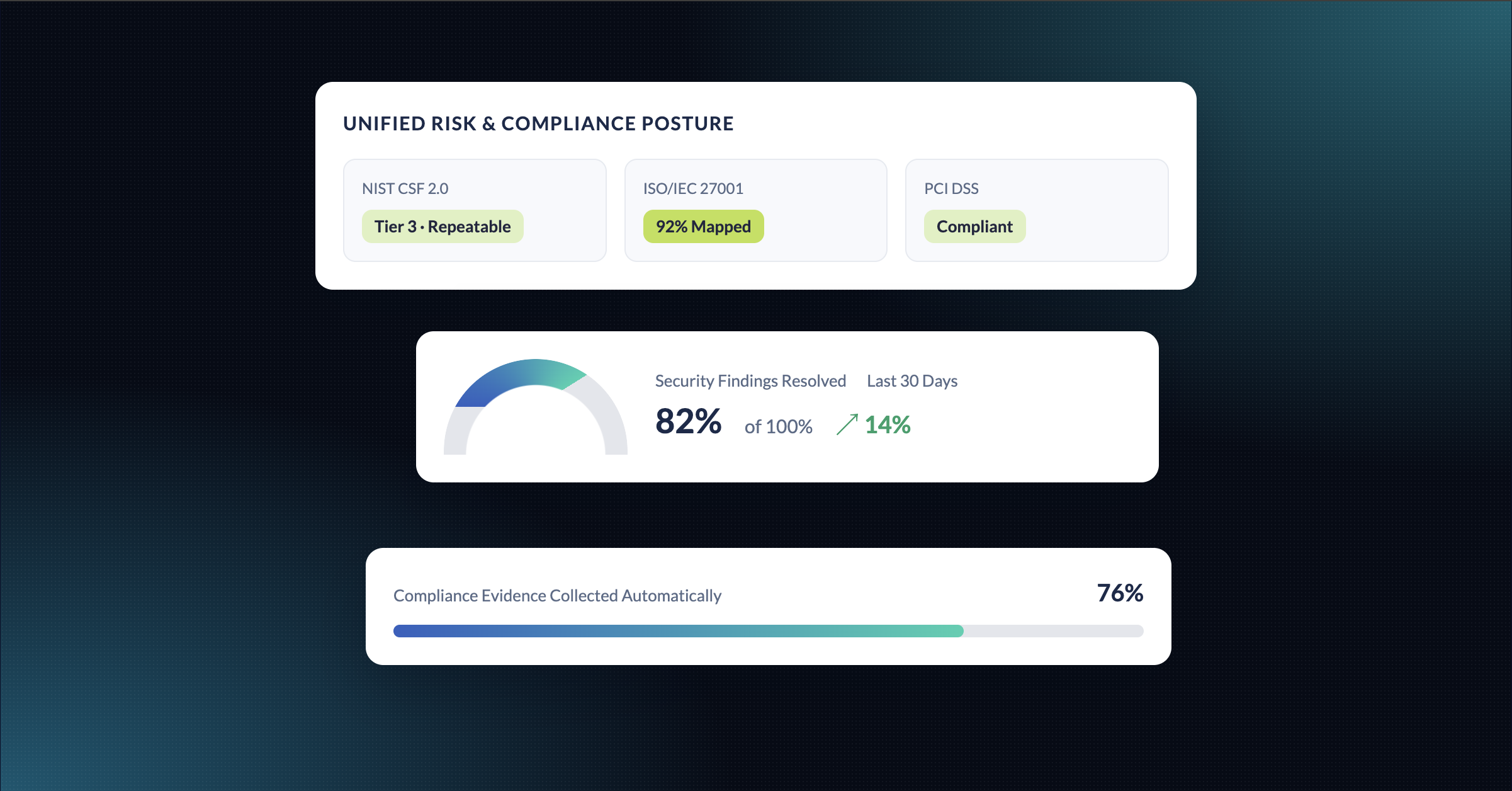
CyberStrong lets you assess a control once and apply the result across every standard it maps to. Customers report an average 70% reduction in assessment time. Efficiency compounds when you add a framework; you extend existing control mappings rather than rebuilding the program.
What to Look for in the Top Continuous Compliance Platforms for Large Organizations
Not every continuous compliance platform was built for enterprise scale. When evaluating the top continuous compliance platforms for large organizations, four capabilities distinguish real-time control intelligence from a scheduler with a dashboard.
The first is real-time control validation rather than periodic sampling; the platform should tell you the state of a control now, not at the last assessment. The second is automated, continuous evidence collection, so audit readiness is a standing condition instead of a quarterly project. The third is control-to-risk linking: the platform should show how a control failure changes your actual risk exposure, not just flag that a checkbox went red. The fourth is financial quantification, so the output means something to the board, not just to the SOC.
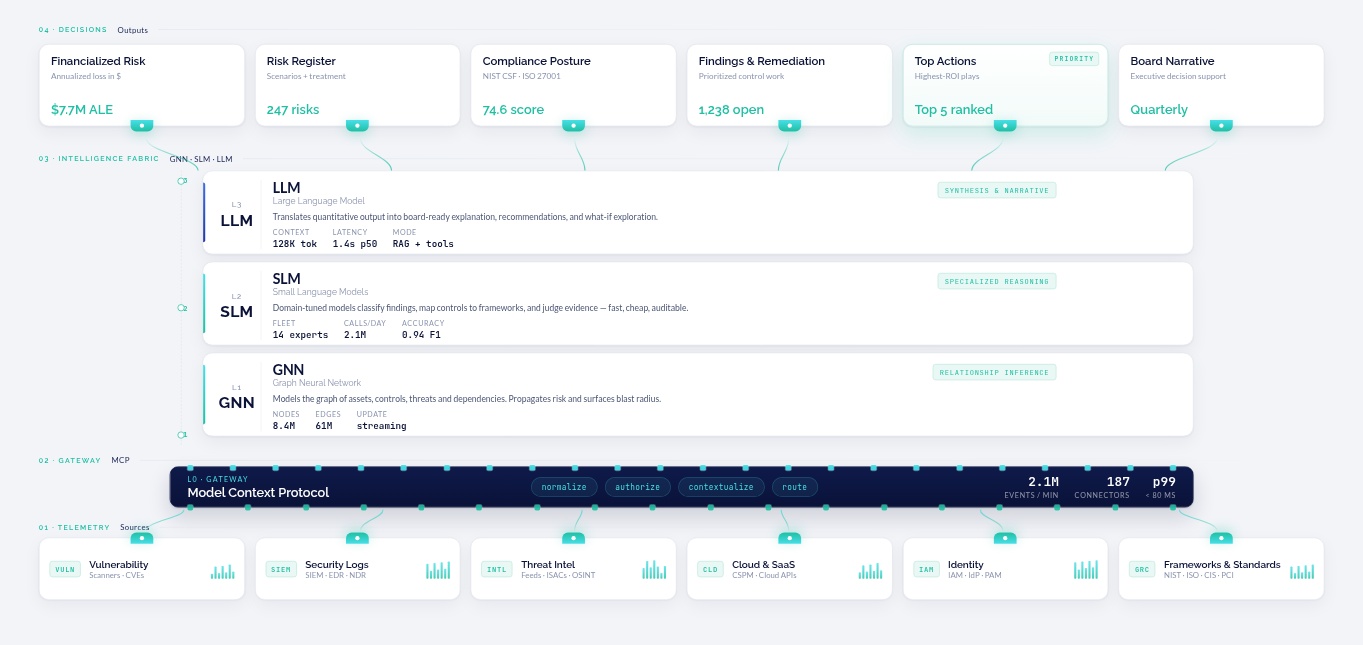
Most platforms do one or two of these well. CyberSaint was built to do all four natively — connecting security operations telemetry to control scores, control scores to the risk register, and the risk register to financially quantified exposure, without a manual translation layer in between. (For a capability-by-capability breakdown against ServiceNow IRM, MetricStream, OneTrust, and Archer, see our enterprise platform comparison.)
Time to Value
Compliance deadlines do not wait for implementation. CyberSaint clients report being live and generating insight in one week or less. Traditional GRC deployments measure time to value in months.
That difference decides outcomes. When you add a business line, acquire a company with different obligations, or get notice of an audit, time to value is the line between meeting the deadline and scrambling to catch up.
Building Compliance Programs That Scale
A durable compliance program is not defined by how much you have implemented. It is defined by how well everything holds together when conditions change. New regulations, framework updates, customer requirements, and infrastructure changes all stress-test the model.
Programs built on point-in-time assessments and manual evidence collection will continue to struggle as regulatory complexity grows. Programs built on real-time control intelligence and automated evidence adapt as requirements evolve.
The enterprises that mature successfully do four things. They reduce friction between governance and engineering. They validate critical controls continuously. They translate technical exposure into business impact. And they build governance into operational workflows instead of running it as a parallel process. Do those four, and compliance stops being a separate program you defend. It becomes a byproduct of running security well.
FAQs About Why Continuous Compliance Breaks in Large Enterprises
What causes continuous compliance software to fail at large enterprises?
Continuous compliance software fails when governance runs on a quarterly cycle, and infrastructure changes hundreds of times a day. Cloud environments drift constantly, while traditional GRC samples posture at a single point in time, creating a gap between documented controls and operational reality. CyberSaint closes that gap with real-time control intelligence that validates your posture as conditions change.
What are the top continuous compliance platforms for large organizations?
The top continuous compliance platforms for large organizations share four traits: real-time control validation instead of periodic sampling, continuous automated evidence collection, control-to-risk linking that ties control status to actual exposure, and financial quantification that boards can act on. CyberSaint delivers all four natively; platforms such as ServiceNow IRM, MetricStream, OneTrust, and Archer typically cover only a subset.
How does real-time control intelligence reduce compliance risk?
It detects control drift within minutes instead of surfacing it during a quarterly audit. A shorter exposure window means less opportunity for an attacker to use the gap. CyberSaint links controls directly to the risks they affect, so you see not just control status but the change in risk it causes.
Why do large enterprises face different compliance challenges than smaller organizations?
Large enterprises span multiple business units, cloud providers, and regulatory jurisdictions. Ownership boundaries can be complex, and evidence must satisfy overlapping framework requirements at once. CyberSaint's framework harmonization lets you assess a control once and map the result to every applicable standard, removing duplicate work.
How can organizations reduce the time spent on collecting compliance evidence?
Automated evidence collection replaces manual screenshot-gathering and documentation-chasing. CyberSaint gathers evidence continuously rather than rebuilding it each audit cycle, and customers report cutting assessment time by more than 70%.
What does it mean to translate cyber risk into financial terms?
It means expressing technical findings as dollar-value exposure that a board can act on. Instead of reporting vulnerability counts, you report that a specific investment reduces a specific amount of exposure. CyberSaint uses patented AI and one of the world's largest cyber loss datasets to quantify how control gaps map to financial exposure.