

.png)
.png)
.png)
%201.png)
.png)
Finding a cyber risk management platform that connects your security operations to executive-level decisions isn't easy. Most platforms focus on either compliance tracking or vulnerability scanning, but rarely both meaningfully.
This guide breaks down the 11 features that matter most when evaluating platforms, then shows you exactly how the top enterprise tools stack up against those criteria. You'll learn what separates feature-rich dashboards from actionable intelligence and why connecting controls to your risk register changes how you communicate with executives.
Why Enterprises Struggle with Cyber Risk Management Platforms
The challenge isn't a lack of tools. Most enterprises have no shortage of security software. The struggle is integration: pulling technical findings from the SOC into a format that means something to a CFO, a board, or a regulator.
Point-in-time compliance assessments go stale the moment you finish them. Vulnerability severity scores don't translate into business impact. And when risk programs live in spreadsheets alongside a half-dozen disconnected tools, the CISO ends up doing manual translation work instead of managing risk.
Enterprises also face compounding complexity from multiple frameworks. NIST CSF, ISO 27001, CIS Controls, SOC 2—each has its own control language, and without crosswalking automation, teams assess the same controls four times over. Financial institutions face another layer of regulatory pressure from FFIEC, DORA, and OCC guidance, which requires documented risk programs, not just security tooling.
The result is a common pattern: technically capable security teams with no reliable way to tell the business what risk actually costs.
The 11 Features CISOs Need in an Enterprise Cyber Risk Platform
These features represent the capabilities that solve real enterprise problems, connecting technical data to business outcomes, reducing assessment burden, and making risk conversations with executives productive.
1. Real-Time Control Scoring
Static assessments become outdated the moment you finish them. Continuous Control Monitoring (CCM) tracks your security posture as telemetry flows in from your existing tools, so when a vulnerability is discovered today, your control scores reflect it immediately.
This responsiveness matters beyond accuracy. When your board asks about current risk exposure, you can answer with confidence rather than qualifying everything with "as of our last assessment." Look for platforms that offer threshold alerts, historical trending, and drill-down from high-level scores to specific control gaps.
2. Financial Risk Quantification
Vulnerability counts and CVSS scores don't move budgets. Dollar figures do. Platforms with built-in financial risk quantification, using recognized methodologies like the FAIR model or NIST 800-30, let you present risk in terms your CFO and board already understand: probable loss ranges, annualized exposure, and return on security investment.
This approach changes budget conversations from "we need more security spend" to "this investment reduces a $3.2M exposure to $800K." That's a different discussion entirely.
3. Framework Crosswalking
Organizations managing NIST CSF, ISO 27001, CIS Controls, and SOC 2 simultaneously shouldn't have to assess the same control four times. AI-powered framework crosswalks a single assessment to every applicable standard automatically, eliminating the duplicate effort that burdens most compliance teams.
4. Control-to-Risk Linking
Knowing your control scores is one thing. Understanding how those controls affect specific risks in your register transforms compliance data into actionable risk intelligence. When a firewall configuration drifts, you want to see immediately which risk items are affected and by how much.
This linkage is what makes cyber risk management operational rather than theoretical. Without it, your risk register is a document you update quarterly. With it, it's a live picture of your exposure.
5. Agentic Evidence Collection
Manual evidence gathering, screenshots, exports, and policy documents are one of the most time-consuming parts of compliance management. Agentic evidence collection uses AI to gather, organize, and maintain compliance documentation automatically from your existing security stack.
This isn't just a time saver. It also means your evidence is always up to date, which matters when regulators or auditors request documentation on short notice. Look for platforms that maintain continuous evidence rather than point-in-time snapshots.
6. Executive Dashboards
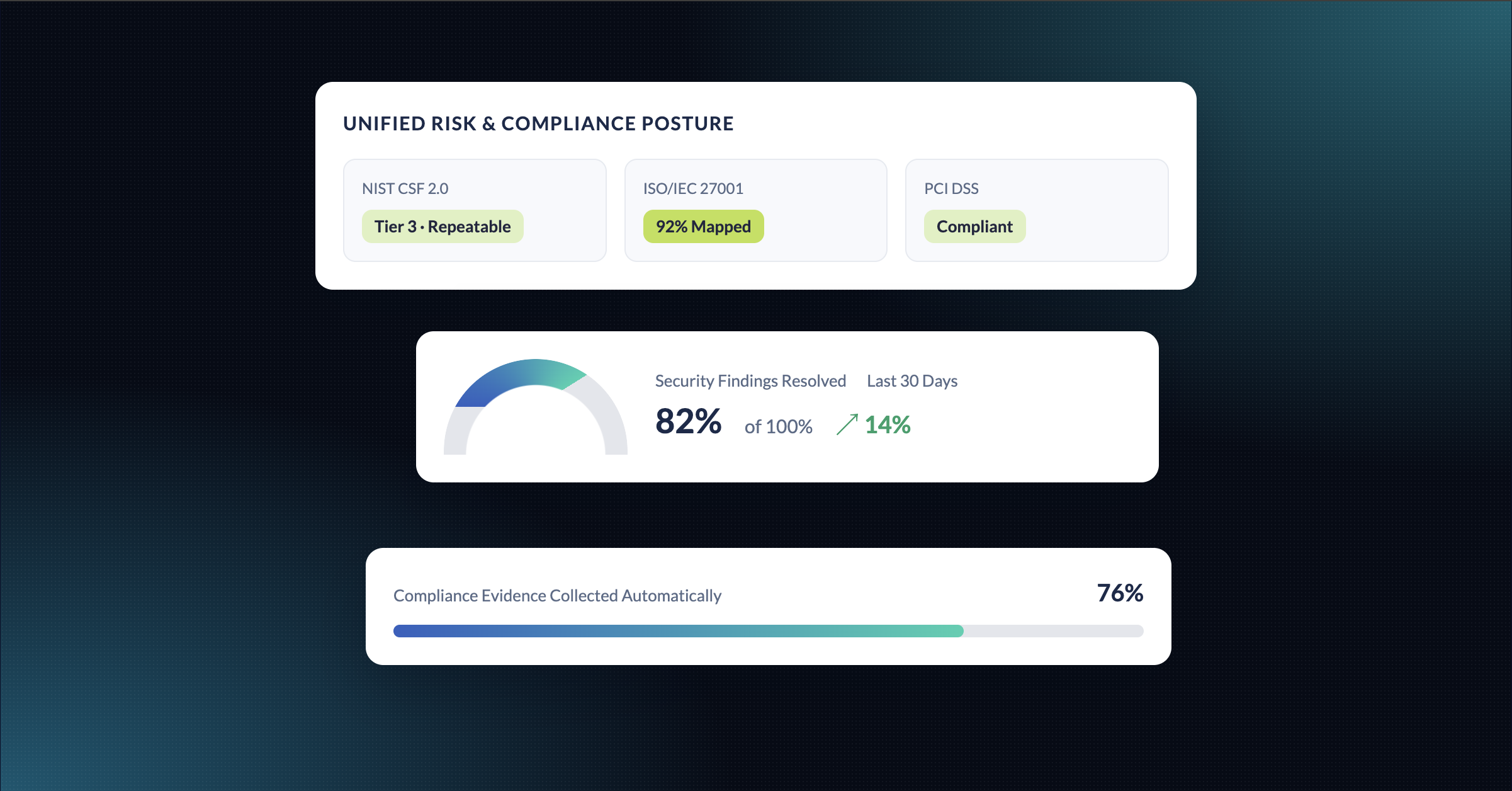
Risk data formatted for security engineers doesn't work in a board meeting. Executive dashboards present the same underlying data in formats that resonate with non-technical stakeholders: financial exposure, trend lines, peer benchmarks, and top-risk narratives.
The goal is a platform where you can walk into a board meeting and pull up a dashboard that tells the risk story without translation. If you still need a separate slide deck to explain your platform's output, the dashboards aren't doing their job.
7. Remediation Prioritization by Business Impact
Severity scores rank vulnerabilities by technical risk. That's not the same as business risk. Remediation prioritization by business impact ranks fixes based on the potential financial or operational consequence of exploitation, not just CVSS scores.
A critical vulnerability in an isolated test environment ranks differently from a high vulnerability in a payment processing system. Platforms that understand this context help teams spend remediation effort where it actually moves the needle on risk exposure.
8. Third-Party Risk Management
Your risk program is only as strong as your vendor ecosystem. Third-party risk management capabilities should assess vendor risk using the same methodology and framework as your internal assessments, not a separate questionnaire-only workflow that produces incomparable data.
Look for platforms that can continuously monitor vendor posture, not just conduct periodic assessments. Supply chain risk has become a primary attack vector, and point-in-time vendor reviews don't reflect how quickly vendor environments change.
9. Benchmark Comparisons
Without industry context, it's hard to know whether your risk posture is acceptable. Benchmark comparisons show how your program measures up against peers in your industry, sector, or revenue band, giving you defensible context for executive reporting and board conversations.
This feature also helps make the case for investment. "Our control scores are in the bottom quartile for financial services" is a more compelling argument for the budget than any internal metric.
10. RoSI Calculations
Return on security investment (RoSI) links your spending to risk-reduction outcomes. ROSI calculations demonstrate, in financial terms, what a given control or investment actually bought, translating security decisions into the same language finance uses to evaluate every other business investment.
This capability is increasingly important as boards hold security leaders to the same accountability standards as other executives.
11. Audit-Ready Reporting
Audit-ready reporting generates compliance evidence and documentation in the format regulators and auditors expect. This means pre-built report templates for frameworks, with evidence artifacts that map directly to each requirement.
For regulated industries, this isn't a convenience feature, it's a compliance requirement. The ability to produce audit documentation on demand, rather than scrambling before an assessment window, is what separates mature risk programs from reactive ones.
How to Evaluate the Top Cyber Risk Platforms Compare
Now that you know what to look for, here's how the leading enterprise platforms stack up across these criteria.
Comparison at a Glance
|
Feature |
CyberSaint |
ServiceNow IRM |
MetricStream |
OneTrust |
Archer |
|---|---|---|---|---|---|
|
Real-time control scoring |
✓ |
✓ |
✓ |
✓ |
✓ |
|
Financial risk quantification |
FAIR, NIST 800-30, custom models |
Custom |
Custom |
Limited |
Archer Insight |
|
AI framework crosswalking |
✓ |
Partial |
✓ |
✓ |
✗ |
|
Control-to-risk linking |
✓ |
✗ |
✗ |
✗ |
✗ |
|
Agentic evidence collection |
✓ |
✗ |
✗ |
✗ |
✗ |
|
Executive dashboards |
✓ |
✓ |
✓ |
✓ |
✓ |
|
Remediation by business impact |
✓ |
Partial |
Partial |
✗ |
Partial |
|
Third-party risk management |
✓ |
✓ |
✓ |
✓ |
✓ |
|
Benchmark comparisons |
✓ |
✗ |
✗ |
✗ |
✗ |
|
ROSI calculations |
✓ |
✗ |
✗ |
✗ |
✗ |
|
Audit-ready reporting |
✓ |
✓ |
✓ |
✓ |
✓ |
CyberSaint
CyberSaint is purpose-built for the challenge most platforms leave unsolved: connecting technical security operations to executive risk decisions in real time. Its architecture links controls directly to the risk register, so changes in your security posture automatically update your risk exposure, no manual reconciliation, no waiting for the next quarterly review.
The platform's financial quantification uses transparent FAIR and NIST 800-30 models, making risk assessments defensible to auditors and understandable to boards. AI-powered crosswalking maps a single assessment to NIST CSF, ISO 27001, CIS Controls, and any other standard your program requires. Organizations using CyberSaint report reducing assessment time by over 70% through automated continuous compliance.
Strengths: The only platform in this comparison with true control-to-risk linking, agentic evidence collection, and peer benchmarking. The connection between SecOps telemetry and board-level reporting is native, not bolted on.
Considerations: The full feature set spans Compliance Hub, Risk Hub, and Executive Hub. Teams new to integrated risk management should plan for a structured onboarding period, though CyberSaint provides guided implementation to accelerate adoption.
ServiceNow Integrated Risk Management
ServiceNow IRM extends its well-established IT service management platform into risk and compliance. Its strength is organizational integration for enterprises already running ServiceNow for ITSM.
GenAI capabilities for control mapping and risk event summarization are a recent addition, and the platform scales effectively across complex enterprise structures.
Strengths: Deep ITSM integration for enterprises already in the ServiceNow ecosystem. Strong workflow automation and scalability.
Considerations: CRQ requires additional modules beyond base licensing. Control-to-risk linking at the depth that CyberSaint provides isn't native. Implementation timelines tend to run longer, and the platform requires ServiceNow expertise to configure optimally. Organizations buying primarily for cyber risk management, rather than extending an existing ServiceNow deployment, may find the investment heavier than alternatives.
MetricStream
MetricStream addresses broad GRC use cases, making it a consideration for enterprises that need a single platform spanning operational risk, regulatory compliance, and cyber risk. Its framework library includes content for ISO 27001, NIST, and other common standards, and AI capabilities help accelerate risk assessments.
Strengths: Wide GRC coverage beyond cybersecurity. Regulatory change tracking keeps compliance programs current as requirements evolve.
Considerations: Platform complexity typically requires dedicated administration resources. Cyber-specific capabilities, particularly in CRQ and SecOps integration, are less mature. Implementation requires significant planning and investment in customization.
OneTrust
OneTrust built its reputation in privacy and has expanded into IT risk and compliance. The platform's 200+ pre-built integrations and 55+ ready-to-use compliance frameworks are genuine differentiators for teams that need broad out-of-the-box workflow connectivity.
Strengths: Extensive integration library and framework coverage. Useful for organizations that need to manage privacy and security risk on a single platform.
Considerations: Cyber risk quantification features are less mature than dedicated CRQ platforms. The platform spans multiple product areas, which requires careful scoping to avoid paying for capabilities you won't use. Full adoption typically requires change management across multiple teams, given the platform's breadth.
Archer
Archer's configurable architecture has made it a long-standing choice for enterprises with complex, non-standard risk management requirements. Its multi-domain coverage handles IT risk, operational risk, audit management, and third-party risk within a single deployment.
Strengths: Highly configurable for organizations with unique workflows. Archer Insight adds CRQ capabilities. Suited for enterprises managing multiple risk domains simultaneously.
Considerations: Configuration requires either specialized internal expertise or a professional services engagement, which increases the total cost of ownership. The user interface has a steeper learning curve than more modern platforms.
NIST Compliance: Which Platforms Actually Deliver
NIST CSF has become the de facto standard for organizing cybersecurity programs, especially for regulated industries, federal contractors, and financial institutions subject to FFIEC guidance. But "NIST alignment" means different things across platforms.
Surface-level NIST support means a framework template and a place to log assessments. Genuine NIST alignment means the platform's operating model reflects how the framework is actually structured: controls organized by Identify, Protect, Detect, Respond, and Recover functions, with risk scoring that maps to those categories.
NIST CSF 2.0 added a sixth function, Govern, making explicit that cyber risk management must integrate with enterprise risk governance. This is where most platforms fall short. A platform can map to NIST CSF 2.0 on paper while still treating security and enterprise risk as separate silos.
CyberSaint supports NIST CSF 2.0's Govern function by connecting security controls directly to the enterprise risk register. This means NIST compliance isn't a separate compliance exercise; it's the same workflow your team uses to manage risk day-to-day. For financial institutions under OCC and FFIEC examination, that integration is the difference between compliance documentation and a defensible risk program.
Of the platforms compared here, CyberSaint and ServiceNow IRM offer the deepest operational alignment with NIST's structure. MetricStream and OneTrust cover NIST framework requirements, but with less of a native connection to how the functions map to daily risk management activities.
Cyber Risk Management for Financial Institutions
Financial institutions face layered regulatory requirements that most cyber risk platforms weren't designed to handle simultaneously. FFIEC guidance, DORA obligations for EU-connected entities, OCC supervisory expectations, and sector-specific cybersecurity requirements each have distinct control frameworks that exhibit significant overlap.
The platforms that work best for financial institutions share three characteristics.
- First, they support multi-framework crosswalking so that a single control assessment maps across FFIEC, NIST, and ISO 27001 without redundant work.
- Second, they produce audit documentation that meets examination standards, not just internally useful reports.
- Third, they quantify risk in financial terms that connect to a bank's existing risk appetite framework and board-level risk tolerance thresholds.
CyberSaint addresses all three. Its FAIR-based financial quantification aligns with how financial institution risk committees already think about risk: in terms of probable financial impact, not just likelihood and severity. Benchmark comparisons with financial services peers provide the industry context that examiners and boards expect.
ServiceNow IRM is also used in financial services, primarily at institutions already running ServiceNow across their IT operations. MetricStream serves financial services clients with regulatory change tracking that monitors updates to FFIEC and OCC guidance. OneTrust's privacy risk capabilities are relevant for financial institutions managing consumer data obligations alongside cybersecurity requirements.
Connecting Security Operations to Compliance: Why Most Platforms Fail Here
The gap between security operations and compliance management is where most risk programs break down. SOC teams generate continuous telemetry, vulnerability scans, threat detection alerts, and incident data, but that data rarely flows into compliance documentation or risk registers in any automated way.
The practical result is two parallel workflows. Security operations run on SIEM dashboards and ticketing systems. Compliance runs on spreadsheets and GRC questionnaires. The CISO manually reconciles them before board meetings, translating technical findings into business language under time pressure.
Platforms that bridge this gap do three things well.
- They pull telemetry from existing security tools into a unified risk view.
- They automatically map technical findings to the controls they affect.
- They translate the resulting risk picture into financial and compliance terms without requiring a manual translation layer.
CyberSaint's architecture was designed specifically for this bridge. Its integrations with security tools feed real-time data into control scores, which in turn automatically update the risk register. When a new vulnerability is confirmed by your scanner, the affected control scores change, the linked risk items update, and your executive dashboard reflects the new exposure, without anyone touching a spreadsheet. This is the advantage of the cyber risk intelligence layer.
This is what it means for a platform to support both security operations and compliance, rather than treating them as separate programs.
Why CyberSaint Is the Right Choice for Enterprise CISOs
CyberSaint stands apart by solving the fundamental challenge facing enterprise security leaders: the technical-to-business translation problem. While other platforms in this comparison are strong at compliance tracking, ITSM integration, or GRC breadth, none natively connects security operations telemetry to CRQ and board-level reporting the way CyberSaint does.
Control-to-risk linking is the capability that makes the difference. When your controls connect directly to your risk register, every change in your security environment automatically updates your risk exposure. This changes how you communicate with executives and boards because your risk data is always up to date, rather than a snapshot from last quarter's assessment.
For teams managing multiple compliance frameworks, AI-powered crosswalking eliminates duplicate assessment effort. For financial institutions, FAIR-based quantification and peer benchmarking provide the financial language and industry context that regulators and boards expect. For organizations trying to connect their SOC to their boardroom, CyberSaint is the only platform in this comparison that makes that connection native rather than manual.
FAQs
Why do enterprises struggle with cyber risk management platforms?
Most platforms address compliance or security operations in isolation, not both together. Enterprises end up with separate workflows for technical vulnerability management and compliance documentation, with no automated connection between them. Platforms that natively link security controls to risk registers, and risk registers to financial impact, solve this problem.
What cyber risk management software works best for financial institutions?
Financial institutions need platforms that support multi-framework crosswalking, produce audit-ready documentation that meets examination standards, and quantify risk in financial terms that align with existing risk appetite frameworks. CyberSaint's FAIR-based quantification and peer benchmarking are particularly well-suited to the financial services context.
Which cyber risk management platform do enterprises use for NIST compliance?
CyberSaint and ServiceNow IRM both offer operational alignment with the NIST CSF, not just framework templates. CyberSaint's support for NIST CSF 2.0's Govern function, connecting security controls to the enterprise risk register, makes it the stronger choice for organizations where NIST compliance needs to integrate with enterprise risk governance rather than operate as a separate program.
Which cyber risk platform supports both security operations and compliance?
CyberSaint is specifically designed for this use case. Its integrations pull telemetry from security tools into control scores, which automatically update the risk register and executive dashboards. This means security operations data flows directly into compliance documentation and financial risk reporting without a manual translation layer. Most other platforms in this comparison handle compliance or security operations well, but not the automation of connections between them.
What is financial risk quantification, and why does it matter for CISOs?
Financial risk quantification translates technical cybersecurity risks into dollar amounts representing potential business impact. Models like FAIR and NIST 800-30 calculate probable loss ranges based on threat likelihood, asset value, and control effectiveness. CyberSaint uses these transparent models so your risk assessments are defensible to auditors and understandable to boards.