

.png)
.png)
.png)
%201.png)
.png)
Security operations and compliance often run on separate tracks—even when they're supposed to work together. If you've been asked to unify both under one roof, you already know the challenge: finding a cyber risk management platform that delivers real-time visibility without creating more work for your team.
That's where the right platform makes a real difference. CyberSaint gives you an AI-native solution that quantifies risk in financial terms and automates compliance across frameworks. This guide walks through the top platforms for 2026 and what sets each apart.
By the end, you'll have a clear view of which cyber risk management platform fits your organization's needs—whether you're in financial services, healthcare, or any sector where regulatory oversight keeps growing.
Quick Guide: 6 Best Cyber Risk Platforms for Enterprise Security and Compliance
- CyberSaint: The best AI-native solution for unifying risk management and compliance automation
- Archer: An established option for configurable enterprise risk programs
- ServiceNow GRC: Works well for organizations already using ServiceNow IT workflows
- MetricStream: Offers broad GRC coverage across multiple risk domains
- OneTrust: Known for privacy management with expanding risk capabilities
- BitSight: Focuses on external security ratings and third-party risk visibility
How We Chose the Best Cyber Risk Management Platforms for SecOps and Compliance
Selecting a cyber risk management platform means looking beyond marketing claims. You need something that actually works when your security team is under pressure, and your compliance deadlines are approaching.
We evaluated platforms based on criteria that matter most to enterprise CISOs and risk leaders:
- Risk quantification in financial terms: Can you translate technical findings into dollar amounts your board understands?
- Framework harmonization: Does the platform let you assess once and map to multiple frameworks, such as NIST, ISO, and CMMC?
- Automation depth: How much manual effort does the platform eliminate from evidence collection and control monitoring?
- Executive reporting: Are risk dashboards built for board-level communication, not just security teams?
- Integration flexibility: Does it connect with your existing security tools without requiring a centralized data lake?
- Time to value: How quickly can your team start seeing results after implementation?
Top Cyber Risk Platforms for SecOps and Compliance in 2026
1. CyberSaint
CyberSaint delivers enterprise-grade cyber risk management through the CyberStrong platform. It connects your security ecosystem using an agentic AI orchestration layer that works across your existing tools—no centralized data lake required.
What makes CyberSaint stand out is how it ties threat likelihood to business impact. CyberSaint translates cyber risk into financially quantified intelligence that flows from your SOC to the boardroom. This means your executive team understands potential losses, their likelihood, and the positive impact of your cyber initiatives.
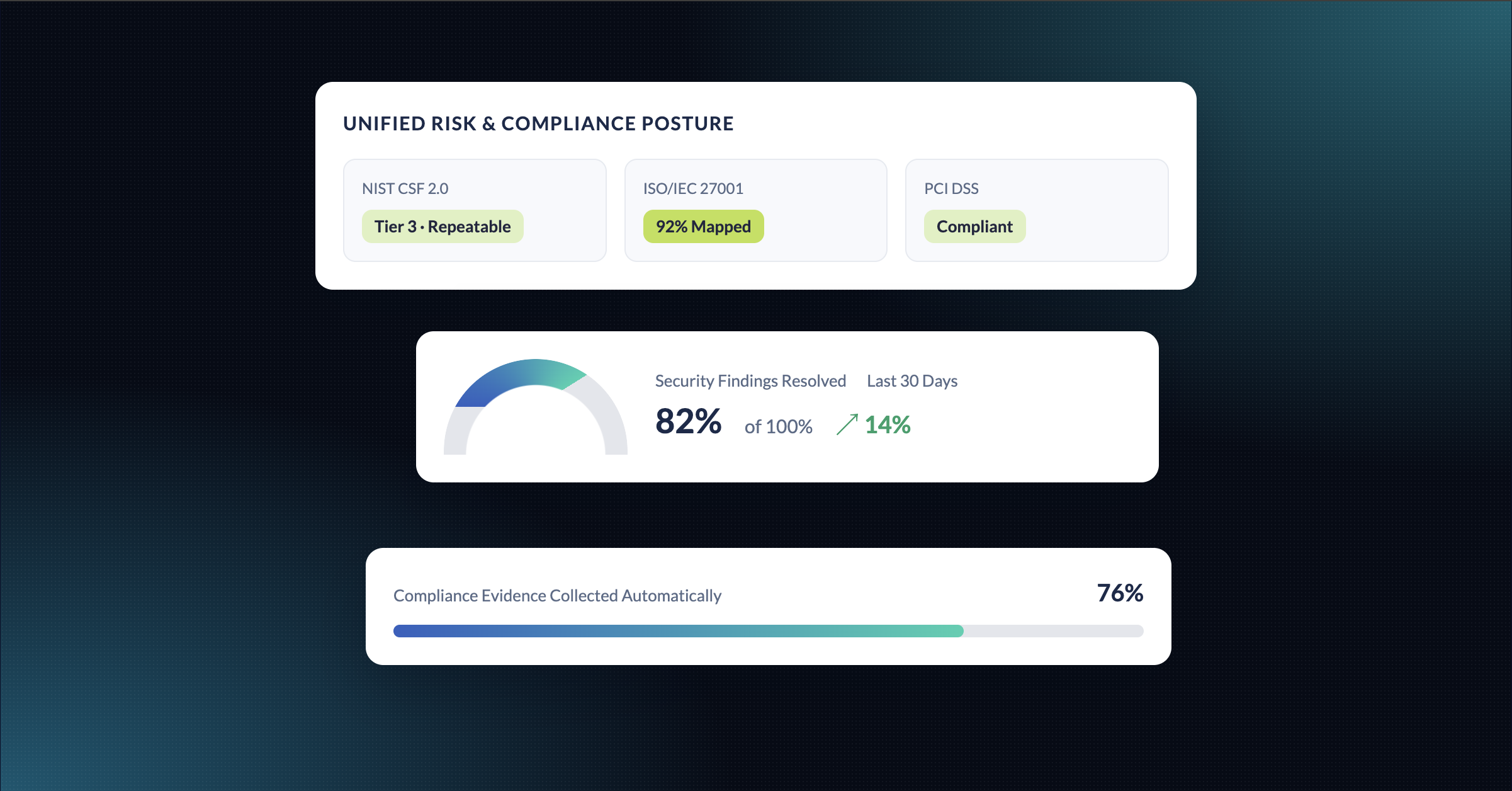
For compliance teams, CyberSaint automates crosswalking between frameworks. You assess once and automatically map results across NIST, CIS, ISO, PCI, CMMC, and dozens of other standards. According to customer reports, this approach delivers an average 70% reduction in assessment time.
CyberStrong Features
- Model-agnotic cyber risk quantification: Uses FAIR and NIST 800-30 models to express cyber risk in dollars and cents, helping you justify security budgets with quantifiable impact
- Automated framework crosswalking: Maps controls across standards so you can assess once and apply compliance evidence everywhere it's needed
- Real-time control monitoring: Scores controls as data from your security tools changes, keeping your risk picture current instead of relying on point-in-time snapshots
- Board-ready reporting: Generates executive dashboards that translate technical risk into metrics leadership can act on
- Agentic evidence collection: Automates the gathering of audit evidence from integrated systems, reducing manual documentation work
- Remediation prioritization: Ranks findings based on business impact and lets you simulate scenarios to compare costs and timelines
CyberStrong Pros and Cons
Pros:
- Achieve a 60–80% reduction in manual compliance work with CyberStrong's AI-powered approach to compliance.
- Only platform linking controls directly to risks for real-time risk management updates
- Customers report being active and seeing insights in one week or less
Cons:
- Platform depth means the initial configuration requires dedicated setup time to maximize value
- Full AI capabilities work most effectively with integrated data sources across your security stack
- Organizations with very simple compliance needs may not require the full platform scope
2. Archer
Archer has been in the GRC space for years, offering a platform that organizations can configure to match their specific workflows. The system handles enterprise risk management, regulatory compliance, and audit management through customizable modules.
The platform focuses on asset protection and onboarding third-party risk. Archer's flexible assessment module connects with existing systems, allowing organizations to adapt as requirements change. IT risk managers often use it to centralize risk data across business units.
- Modular architecture: Pick and deploy specific use cases for enterprise risk, compliance, or audit management based on your needs
- Third-party onboarding workflows: Conducts due diligence assessments and establishes risk profiles for vendors
- Custom dashboards: Configurable reporting tools for interpreting risk data across the organization
Archer pros and cons
Pros:
- Deep configurability for organizations with specific workflow requirements
- Established track record in large enterprise environments
- Multiple use cases covered under one platform umbrella
Cons:
- Implementation complexity can extend project timelines significantly
- Interface requires training for new users to navigate effectively
- Total cost includes professional services for extensive customization
3. ServiceNow GRC
ServiceNow GRC integrates risk and compliance management into the broader ServiceNow platform. For organizations already running IT service management through ServiceNow, the GRC module adds governance capabilities without introducing a separate system.
The platform connects incident response with compliance workflows. When issues arise, they flow through the same ticketing system your IT team already uses. ServiceNow GRC also includes workflow automation through no-code playbooks.
- ITSM integration: Links risk management to existing IT service workflows and ticketing processes
- Policy and compliance management: Tracks regulatory requirements and maps them to internal controls
- Automated workflows: No-code playbook builder for creating custom compliance processes
ServiceNow GRC pros and cons
Pros:
- Minimal integration effort for existing ServiceNow customers
- Unified data environment across IT and compliance functions
- Workflow automation reduces repetitive task management
Cons:
- Primary value depends on the existing ServiceNow platform investment
- Risk quantification in financial terms requires additional configuration
- Organizations not using ServiceNow face steeper adoption curves
4. MetricStream
MetricStream offers a connected GRC platform covering enterprise risk, compliance, audit, and cybersecurity functions. The system synchronizes operations across departments, presenting governance data in a centralized view.
The platform includes regulatory change-management automation, AI-based alerts, and horizon scanning. MetricStream also supports risk quantification to represent exposures in monetary terms.
- Regulatory change management: Automated alerts and impact analysis for evolving compliance requirements
- Control monitoring: Automates compliance checks for IT controls across the organization
- Risk quantification: Translates IT and enterprise risk exposures into monetary values
MetricStream pros and cons
Pros:
- Covers multiple risk domains under one connected platform
- Regulatory horizon scanning helps anticipate compliance changes
- Recognized by multiple analyst firms for GRC capabilities
Cons:
- Platform breadth may exceed what smaller organizations need
- Full deployment involves multi-phase implementation planning
- Pricing structure reflects enterprise-scale deployments
5. OneTrust
OneTrust built its foundation in privacy management and has since expanded into broader GRC. The platform now covers third-party risk management, data governance, and ethics compliance alongside its privacy modules.
For organizations where data privacy drives compliance priorities, OneTrust brings those workflows together with risk assessment capabilities. The system includes vendor risk management features for tracking third-party compliance postures.
- Privacy management: Consent management, data mapping, and privacy impact assessments
- Third-party risk: Vendor assessments and ongoing monitoring of compliance status
- Data governance: Tools for managing data classification and access controls
OneTrust pros and cons
Pros:
- Privacy capabilities are well-developed and widely adopted
- Integrates privacy workflows with broader risk management
- Third-party management covers vendor lifecycle needs
Cons:
- Cyber risk quantification in financial terms is not the primary focus
- Security operations integration requires additional configuration
- Organizations prioritizing SecOps may find privacy emphasis less relevant
6. BitSight
BitSight focuses on external security ratings that assess organizations from the outside in. The platform monitors digital footprints and calculates risk scores based on externally observable data points.
Third-party risk management is a primary use case. BitSight lets you monitor vendor security postures through ratings that update based on observable changes in their attack surface. This helps procurement and security teams make faster decisions about vendor relationships.
BitSight features
- Security ratings: Calculate risk scores based on external observations of an organization's security posture
- Third-party monitoring: Tracks vendor security ratings and alerts on changes
- Attack surface visibility: Maps externally visible assets and vulnerabilities
BitSight pros and cons
Pros:
- Third-party risk visibility without requiring vendor cooperation
- Ratings update based on observable security changes
- Useful for vendor due diligence and ongoing monitoring
Cons:
- External ratings do not capture internal control effectiveness
- Compliance automation requires integration with other platforms
- Primary focus is on third-party risk rather than full SecOps and compliance unification
Comparing the Top Cyber Risk Platforms
| Platform | Model-Agnostic Risk Quantification | Framework Crosswalking | Continuous Control Monitoring |
|---|---|---|---|
| CyberSaint | ✓ FAIR + NIST 800-30 | ✓ 50+ frameworks | ✓ Agentic automation |
| Archer | ✗ | ✓ Configurable | ✗ |
| ServiceNow GRC | ✗ | ✓ With configuration | ✓ ITSM-integrated |
| MetricStream | ✓ Risk quantification | ✓ Multiple frameworks | ✓ IT controls |
| OneTrust | ✗ | ✓ Privacy-focused | ✗ |
| BitSight | ✗ | ✗ | ✓ External ratings |
How Can Cyber Risk Solutions Help Financial Institutions with Compliance?
Financial services organizations face overlapping requirements from SEC cyber disclosure rules, NYDFS cybersecurity regulations, and sector-specific mandates like DORA in Europe. A cyber risk management platform helps by centralizing evidence collection and mapping controls across these frameworks simultaneously.
The challenge for financial institutions isn't just meeting one regulation—it's demonstrating compliance across all of them without duplicating effort. CyberSaint addresses this by harmonizing frameworks, allowing you to assess controls once and automatically apply the results across all applicable standards.
Board reporting also matters more in financial services. Regulators expect organizations to demonstrate that their leadership understands cyber risk exposure. The Gartner Cybersecurity Business Value Benchmark highlights how outcome-driven metrics help CISOs communicate the value of security investments to boards and CFOs.
What to Look for When Evaluating Cyber Risk Management Software?
Start by identifying your primary use case. Are you trying to unify security operations with compliance workflows? Do you need to translate technical risks into financial terms for your board? Your answers shape which platform capabilities matter most.
Integration flexibility deserves close attention. Your security stack includes multiple tools—SIEMs, vulnerability scanners, cloud infrastructure—and your risk platform should work with what you already have. CyberSaint connects across your existing ecosystem without requiring you to replace tools or build a centralized data lake.
Consider time to value carefully. Some platforms require months of implementation before you see results. CyberSaint customers report being active and generating insights in one week or less, according to company data. That rapid deployment matters when compliance deadlines don't wait.
Why CyberSaint is the Best Cyber Risk Platform for SecOps and Compliance
Unifying security operations and compliance isn't just about having one platform, it's about having the right intelligence at every level of your organization. CyberSaint makes cyber risk actionable by connecting technical findings to business outcomes in a way that both SOC analysts and board members can understand.
The difference shows up in how CyberSaint handles risk quantification. Instead of abstract scores or color-coded heat maps, CyberSaint expresses risk in dollars and cents using credible methodologies like FAIR and NIST 800-30. This financial translation helps you justify security budgets and demonstrate the ROI of cyber initiatives.
For compliance teams, CyberSaint eliminates the repetitive work that consumes assessment cycles. The platform's AI-powered crosswalking maps your control evidence across frameworks automatically, including NIST CSF, ISO 27001, CMMC, PCI DSS, and more. You assess once and satisfy multiple standards, cutting assessment time by an average of 70%.
Ready to see how CyberSaint unifies your security operations and compliance programs? Request a demo to explore the platform firsthand.
FAQs: Cyber Risk Platforms for SecOps and Compliance
What is a cyber risk management platform?
A cyber risk management platform is software that helps organizations identify, assess, and reduce security risks while managing compliance with regulatory frameworks. CyberSaint adds AI-powered automation and financial risk quantification to make this process faster and more actionable for enterprise teams.
How do cyber risk platforms differ from GRC tools?
Traditional GRC tools focus primarily on governance and compliance documentation. Cyber risk platforms like CyberSaint connect directly to your security ecosystem, pulling real-time data to quantify risk and monitor controls. This integration creates a living risk picture rather than point-in-time snapshots.
Why is financial risk quantification important for cyber risk management?
Boards and executives make decisions in financial terms. CyberSaint translates technical risk findings into dollar amounts, showing potential losses and the ROI of security investments. This financial language helps CISOs secure budgets and demonstrate value to leadership.
Can cyber risk platforms help with multiple compliance frameworks?
Yes. CyberSaint automates framework crosswalking so you can assess controls once and map results to NIST, ISO, CMMC, and dozens of other cybersecurity frameworks and standards. This automation eliminates duplicate work and keeps compliance current across all applicable regulations.
How long does it take to implement a cyber risk management platform?
Implementation timelines vary by platform. CyberSaint customers report being active and seeing initial insights in one week or less. The platform integrates with your existing security tools without requiring a centralized data lake, significantly accelerating deployment.
What makes CyberSaint different from other cyber risk platforms?
CyberSaint combines AI-native risk quantification, automated framework crosswalking, and real-time control monitoring in one platform. It's the only solution that links controls directly to risks to enable dynamic cyber risk management updates, and was recognized by Gartner in the 2024 Hype Cycle for Cyber Risk Management.