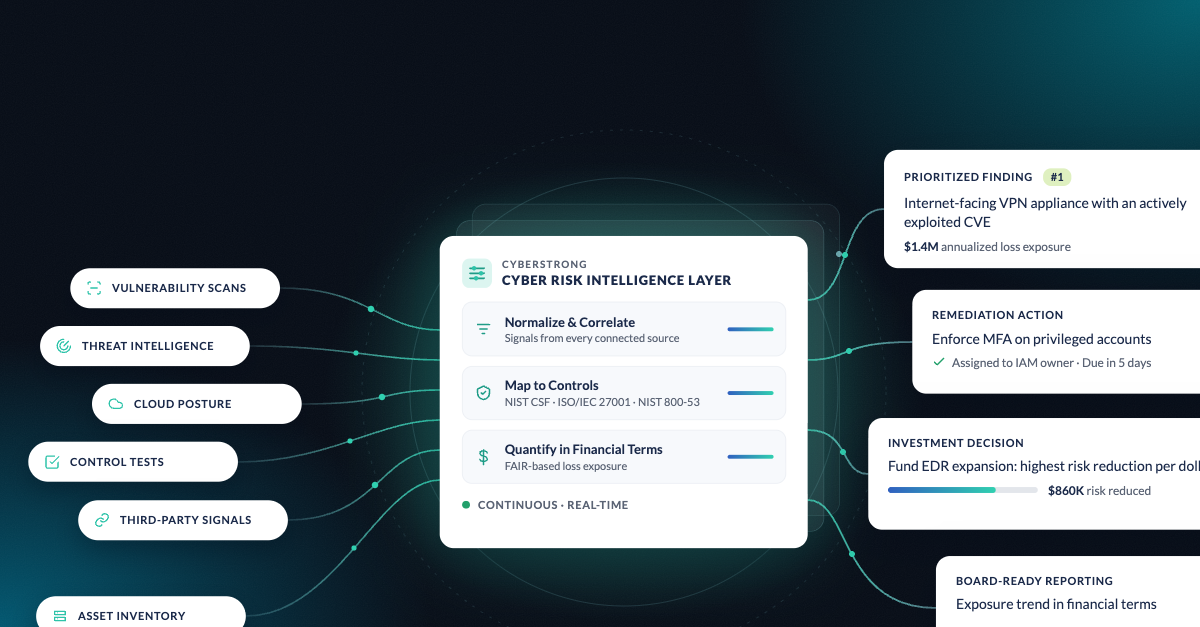
Enterprises struggle with cyber risk management platforms because most platforms were built to manage one slice of risk, and enterprise risk does not arrive in slices. A GRC platform tracks controls but cannot see live exposure. An exposure management tool ranks likelihood but cannot say what a finding costs the business. Both produce output. Neither produces a decision.
The result is a platform that sits alongside the rest of the stack instead of connecting it, and a security team that still does the correlation work by hand.
This page breaks down the three failures behind that pattern, and the evaluation criteria that separate a platform that closes them from one that adds another dashboard.
Key Takeaways
- Enterprises struggle with cyber risk management platforms for three connected reasons: data that never joins up, likelihood that never marries business impact, and reporting cycles slower than the environment they describe.
- A platform that only scores controls, or only ranks vulnerabilities, hands the correlation work back to your team. That work is the cost the platform was supposed to remove.
- Boards ask what exposure is worth, not how many findings are open. A platform that cannot answer in dollars leaves your team translating manually before every meeting.
- Evaluation should test quantification transparency, integration depth, time to value, and framework crosswalking, not the length of a feature list.
- The CyberStrong platform connects likelihood to business impact across the tools already in place, so control data, the risk register, and executive reporting run off the same live picture of financially quantified risk.
What Causes Cyber Risk Management Platforms to Fail at Enterprise Scale?
You know the pattern from the inside. Controls are documented. Scanners run on schedule. Frameworks are mapped, findings are tracked, and the program looks healthy in review.
Then the board asks what your top five risks are worth, and it takes three analysts a week to assemble the answer.
That gap has three causes, and they compound.
-
The data problem. The average enterprise runs more than 75 security tools. Each one is a walled data vault with its own scoring model, dashboard, and definition of what "critical" means. The data exists. It never joins.
-
The context problem. Likelihood and impact live in different systems and different teams. Exposure tools rank what could happen. Risk platforms estimate what the business would lose. Neither side sees the other's half, so prioritization comes down to judgment calls nobody can defend in writing.
-
The speed problem. Exploits get built within hours of disclosure. Enterprise patch cycles still run 30 to 45 days, and risk reporting still runs quarterly. The exposure window opens faster than the process that measures it.
Most platforms in this market solve one of the three and inherit the other two.
Why Consolidation Projects Stall
When data is fragmented, the instinct is to centralize it. Build the security data lake, pipe everything into it, and reason over the result.
Enterprises have spent years on that approach. The projects stall for structural reasons rather than technical ones. Every source system has a different schema and a different refresh cadence. Normalizing them is a standing engineering commitment, not a migration. And the moment a team adds a tool, the pipeline needs work again.
The alternative is to leave the data where it is and connect it in place. An agentic orchestration layer reads from the tools already deployed through their existing APIs, correlates across them, and writes context back — without a central store to maintain and without ripping anything out. The distinction matters for evaluation: a platform that requires you to move your data first has moved its implementation cost onto your team.
Why Likelihood Without Impact Stalls Decisions
A severity score tells you a vulnerability is serious in general. It does not tell you whether it is serious here.
The same CVE on a test server and on the system that clears customer payments carries the same score and radically different consequences. Without the connection between finding, asset, business process, and dollar exposure, your team is left ranking work by a number that was never calibrated to your organization.
Connected intelligence returns a chain instead of a score: this vulnerability, on this asset, supporting this revenue-generating process, worth this much unaddressed. That chain makes prioritization defensible when someone asks why one project got funded, and another did not.
Stop choosing between likelihood and impact. Intelligence means both.
Why Board Reporting Exposes the Gap
The gap between technical telemetry and executive decision-making shows up most clearly in the boardroom, where translation can no longer be deferred.
Directors have made their expectations explicit. The 2026 NACD Director's Handbook on Cyber-Risk Oversight calls for concise, quantitative, forward-looking reporting that connects cybersecurity performance to business outcomes, and notes that many boards still receive updates that are overly technical, inconsistent across business units, or disconnected from strategy.
CSO Online made the same point more bluntly in February 2026: boards do not need cyber metrics; they need risk signals. A metric describes the security program. A signal describes a consequence the business can act on.
The reframe is small. The difference is not. "We have 4,000 open vulnerabilities" tells a director nothing they can decide on. "Twelve million dollars in unaddressed exposure, concentrated in three systems, reducible to two million by closing eight findings this quarter" is the same underlying data expressed as a choice. One version is a report. The other is a decision.
Platforms that cannot make that translation push it onto your team, manually, before every meeting.
Streamline your board report strategy with our all-in-one cybersecurity board report.
The Evidence Burden Behind the Frustration
Part of what makes enterprise platforms feel like overhead is the work they leave in place. Evidence collection is the clearest example. In many programs, someone's full-time job is pulling screenshots and exports for the next audit, documentation that is already stale when an auditor opens it.
If a platform does not collect and validate evidence from connected systems on an ongoing basis, it has automated the reporting and left the labor.
Real-time control monitoring changes the shape of that work. Control evidence is gathered and validated continuously from the systems that produce it, so audit preparation becomes confirming what you already know. Compliance becomes a byproduct of doing security right, not a separate project staffed every cycle. CyberStrong users report an average 70% time savings across assessments.
What Is a Cyber Risk Management Platform Supposed to Do?
A cyber risk management platform centralizes assessment, quantification, remediation, and reporting in one environment, pulling from existing security investments and translating that data into business-relevant intelligence.
The functional test is narrower than the definition. A mature platform connects control posture directly to entries in the risk register, so risk scores update as control data changes. That connection produces a living picture of exposure instead of a quarterly snapshot, and it is the capability most often missing from tools that carry the label.
The platforms that pass that test belong to a different category: the cyber risk intelligence platform. Instead of adding another system that holds another slice of data, a cyber risk intelligence platform connects the systems you already run—tying threat likelihood to business impact in real time across every security domain.
What Cyber Risk Quantification Models Should the Platform Support?
The platform should support recognized methodologies rather than a proprietary score. NIST 800-30 provides a standardized path from qualitative assessment to quantitative scoring. FAIR (Factor Analysis of Information Risk) expresses technical risk in financial terms your CFO already works in.
Transparency matters more than the model. You need to explain to a director exactly how the platform arrived at a specific loss figure. If the vendor cannot articulate that calculation clearly in a demo, your board will have the same question when you present the number.
CyberStrong's cyber risk quantification uses transparent FAIR and NIST 800-30 models informed by real-world cyber loss data, so every figure you present traces back to a method, not a black box.
Learn how to select the right cyber risk quantification solution for your organization.
Can You Prioritize Remediation by Financial Exposure?
Identifying gaps is half the work. The platform should tell you which gap to close first, based on what closing it is worth.
Look for scenario modeling. If you close Gap A, how far does exposure fall? If you fund Project B instead, how do the returns compare? CyberStrong expresses control and risk remediation in financial terms, letting you model cost, exposure reduction per dollar invested, and timeline before you commit resources. That turns a remediation plan into a budget argument rather than a technical backlog.
How Real Is "Real-Time" Control Monitoring?
Real-time monitoring determines how quickly the platform reflects a change in your environment. Ask how data gets in: does the platform require a centralized data lake, or does it read from your existing ecosystem through direct APIs? The answer sets your implementation timeline and your ongoing operational cost.
CyberStrong's cyber risk intelligence fabric queries data from your connected tools in place and rescores controls as that data changes.
How Deep Do the Integrations Actually Go?
The number of integrations a platform advertises matters far less than what those integrations carry. A connection that pulls status data is not the same as one that ingests granular control evidence and moves a risk score.
Test the connections you depend on: vulnerability tools, cloud providers, SIEM, and identity systems. Each should feed your control assessments and risk register directly, not populate a separate view. CyberStrong's intelligence fabric maps relationships between assets, vulnerabilities, business processes, and live threat data, so assessments reflect current conditions rather than last quarter's export.
Do You See Third-Party Risk in the Same View?
Your exposure extends through vendors, supply chain partners, and SaaS providers. Third-party risk visibility should sit alongside your internal assessment data, not in a separate program.
Look for both perspectives: inside-out, meaning how your vendors' controls are actually performing, and outside-in, meaning what their external attack surface looks like. Then ask how the platform tracks that posture over time. A vendor's risk shifts as their environment shifts, and a point-in-time questionnaire will not tell you when it does.
Does the Platform Crosswalk Frameworks Automatically?
Financial institutions carry overlapping obligations from SEC cyber disclosure rules, NYDFS requirements, and DORA. Healthcare organizations run HIPAA alongside NIST CSF. Government contractors manage CMMC, DFARS, and NIST 800-171 at once. The controls overlap heavily. The formats do not.
Automated crosswalking lets you assess a control once and apply the result to every standard it maps to. CyberStrong's streamlined approach to security compliance handles that mapping, and the efficiency compounds when you add a framework; you extend existing mappings instead of rebuilding the program. For a view of how security and AI governance frameworks fit together, see the top security, risk, and AI governance frameworks for 2026.
How Long Until the Platform Produces Something Usable?
Ask vendors directly: how long from signature to first actionable insight, what onboarding requires from your team, and how much internal IT support deployment consumes.
Platforms that arrive with pre-configured frameworks and risk models start producing output on a different timescale than those requiring months of data migration and custom configuration. Most CyberStrong clients are active in the platform within one week or less.
Will the Platform Scale as the Program Matures?
The platform you select now should accommodate a more mature program later without a migration. Can you begin with compliance assessment and add quantification as the program grows? Can you expand from one business unit to the enterprise without an architectural change?
CyberStrong's scalable approach to governance, risk, and compliance supports that progression, so capability expands as the program does. On day one, it is additive: your stack finally talks to itself. Over time, teams can see where they pay twice for overlapping capabilities, turning tool sprawl into a budget reallocation decision rather than a vendor-displacement project.
Siloed Risk Management vs. Connected Cyber Risk Intelligence
| Evaluation dimension | Siloed risk management | Connected cyber risk intelligence |
|---|---|---|
| Data model | Each tool holds its own vault with its own scoring | Findings correlated in place across existing tools |
| Deployment | Centralized data lake or rip-and-replace migration | Additive layer reading through existing APIs |
| Risk view | Likelihood or impact, rarely both | Likelihood tied to business impact in one chain |
| Update cadence | Point-in-time assessment, quarterly refresh | Scores move as connected control data changes |
| Board output | Control counts and vulnerability totals | Dollar exposure, trend, and exposure reduction per dollar |
| Framework work | Reassess the same control per standard | Assess once, crosswalk to every mapped standard |
| Evidence | Manual collection each audit cycle | Collected and validated continuously from source systems |
| Analyst time | Spent reconciling data between systems | Spent on decisions that need judgment |
8 Questions to Ask During a Platform Evaluation
- Which quantification models does it support, and can our team audit a specific calculation from input to dollar figure?
- Can the platform model remediation scenarios with financial impact projections?
- How does the platform produce executive reporting without manual data manipulation?
- How does the platform update risk scores when underlying control data changes — in real time, daily, or in batches?
- What evidence collection runs automatically, and which of our existing tools does it draw from?
- How many frameworks ship out of the box, and how does automated crosswalking actually work?
- What does implementation look like for an organization of our size, and what do you need from our team?
- Where do our people direct and approve the workflow steps the platform executes?
Red Flags During Vendor Evaluation
Certain patterns in an evaluation predict post-implementation problems.
Watch for demos that cannot show live data moving through an integration. Pre-loaded demo environments hide the effort required to get your data into the platform, and that effort lands on your team in month two.
Be cautious of quantification you cannot explain. If a vendor cannot walk you through how a dollar figure was derived, you inherit that ambiguity the first time a director asks.
Watch for platforms that need substantial professional services to configure basic functionality. High configuration overhead delays value and raises total cost well past the subscription line.
Finally, ask what happens when the platform takes an action. Agentic capability should mean the system executes workflow steps your team approves, inside your existing change management. A vendor describing fully autonomous security is describing something your auditors will not accept.
Closing the Gap Between Siloed Data and Cyber Risk Intelligence
Enterprises struggle with cyber risk management platforms that inherit the fragmentation they were bought to fix. The tool joins the stack, adds a dashboard, and leaves the correlation work in place.
The platforms that break the pattern do three things. They connect to the tools already deployed rather than requiring migration. They tie likelihood to business impact so you can defend prioritization. And they express exposure in financial terms without a manual translation step before every board meeting.
CyberStrong helps enterprise security teams turn fragmented data into real-time, financially quantified risk intelligence by orchestrating context across every tool they already have.
Your team stops doing the correlation work. They start making the calls that matter.
Request a demo to see how CyberStrong connects your security operations to executive-level decision-making.
FAQs About Why Enterprises Struggle With Cyber Risk Management Platforms
Why do enterprises struggle with cyber risk management platforms?
Most platforms manage one slice of risk, while enterprise risk spans all of them. Data stays locked in individual tools, likelihood is never tied to business impact, and reporting runs on a slower cycle than the environment it describes. The platform becomes another system in the stack rather than the layer that connects it. CyberStrong addresses all three by correlating data across the tools already in place and expressing the result in financial terms.
What makes a cyber risk platform different from traditional GRC software?
GRC software tracks controls, policies, and audit findings on an assessment cycle. A cyber risk intelligence platform connects control posture directly to financial risk quantification and executive reporting. CyberStrong links controls to risk register entries so scores move as control data changes, rather than refreshing when someone runs the next assessment.
How should a cyber risk platform support board reporting?
It should express exposure in financial terms and present trends, remediation progress, and exposure reduction per dollar invested in a format directors can act on without interpretation. CyberStrong's Executive Dashboard produces that view from live control data, so no one on your team has to translate spreadsheets the week before the meeting.
What role does AI play in a cyber risk management platform?
The useful distinction is which layer does what. An intelligence fabric maps the relationships between findings, assets, business processes, and dollar exposure. An agentic orchestration layer executes workflow steps your team approves, inside existing change management. In CyberStrong, those layers handle the correlation work that currently consumes analyst hours, so your people can focus on decisions that require judgment.
Can a single platform handle multiple compliance frameworks?
Yes, when it supports automated crosswalking. You assess a control once, and the platform applies the result to every standard that control maps to, which removes the duplicate assessment work that comes with overlapping obligations like SEC rules, NYDFS, DORA, HIPAA, and CMMC. Adding a framework then means extending existing mappings rather than rebuilding the program.
What data should a cyber risk platform ingest for accurate scoring?
At minimum, vulnerability scanners, SIEM, identity systems, cloud providers, and endpoint tools. More important than the source list is the depth of each connection. CyberStrong pulls data from these sources via direct API access and updates control scores and quantified exposure as conditions change.